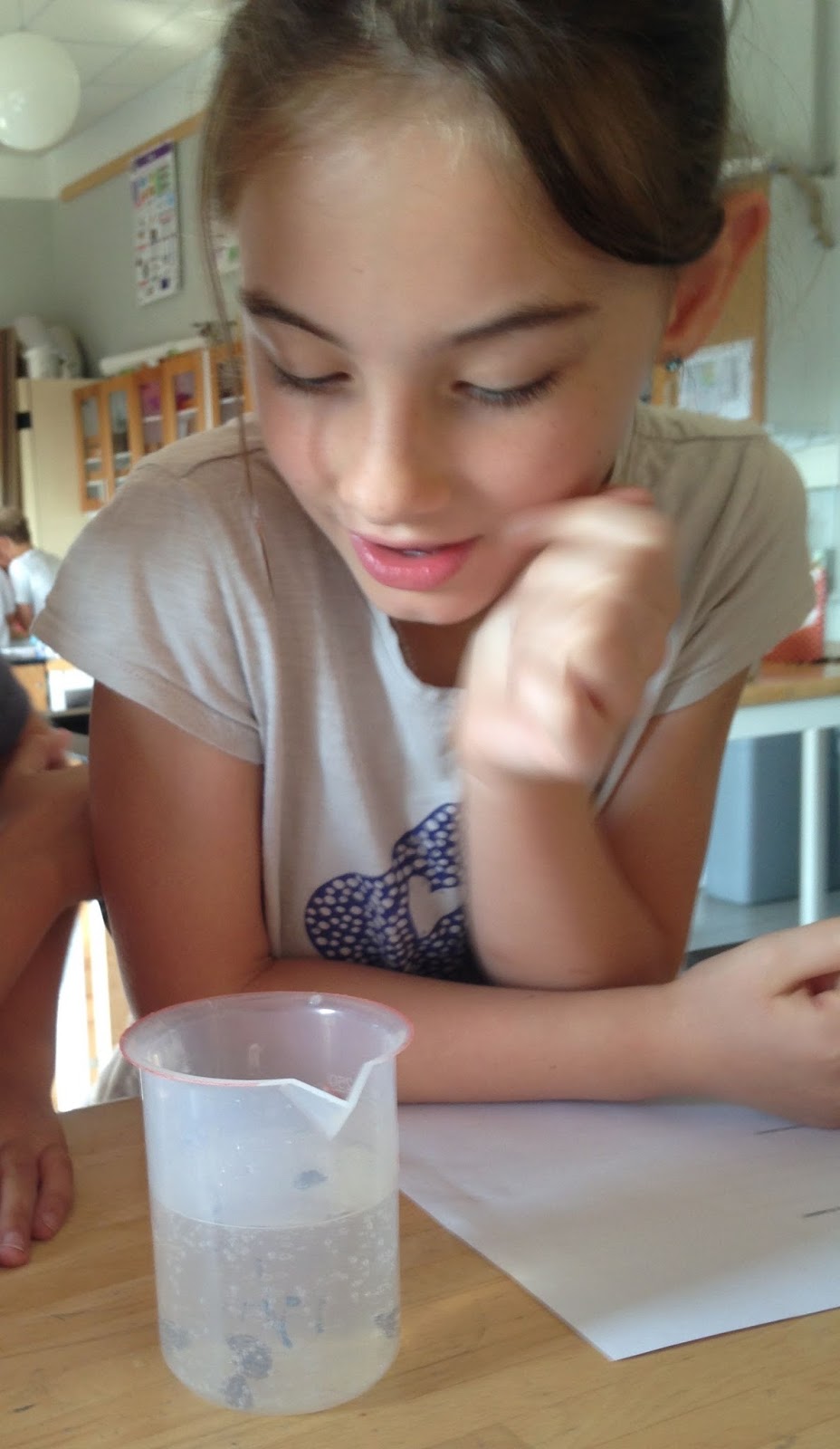
Grade 3 is testing and comparing chocolates. At the same time we are learning about properties of solids, liquids and gases. We will continue to look at melting and the temperatures at which different substances melt. As you can imagine the kids love these chocolate lessons.
tisdag 6 oktober 2015
söndag 27 september 2015
Seed Dispersal Investigation
Plants have developed may strategies for dispersing their seeds. Grade 7 students collected seeds on our walks in Humlegården and in our own school yard. One dispersal method we tried to model was the "helicopter" strategy that lime and maple trees, among others, use.
Students built their own models of seed dispersers. I am always surprised at the way these students come up with new ideas. Here is a seed carrier model using feathers.
Other students made classic paper helicopters and changed the mass or wing size. It was important to only change one variable in order to have a fair test.
Students dropped their models and timed how long they took to hit the ground. We used the assumption that the longer seeds are in the air, the greater chance they have to travel away from their parent plant.
onsdag 23 september 2015
Moon Craters
Grade 6 is working on their first MYP science investigation. Our statement of inquiry for the Solar System is: Scientists observe patterns and use them to construct models that explain natural phenomena. Our assessments are somehow linked to this. The first investigation is to measure how a certain factor affects the size of moon craters. Of course we can't travel to the moon and wait around for a meteorite to come crashing down, so we build a model and observe the patterns we see. For this investigation our moon regolith was made from flour and a thin layer of cocoa powder. Students dropped different balls into the "regolith" and made different measurements. Some chose to change the size of the ball, some chose to change the height of the drop. For a dependent variable, some chose the length of the rays thrown from the crater, others chose to measure crater depth or diameter. Students recorded and analyzed their results using google sheets. It is a messy but fun and productive lab.
Measuring ejecta rays.
A nice model crater.
Teamwork!
What happened when the "meteorite" came from an angle.
Impact!
Messy lab!
måndag 21 september 2015
Chemical Changes with Yeast
In grade 4 we have observed some different chemical changes using yeast. The first was elephant toothpaste. There is an enzyme in yeast that breaks down hydrogen peroxide into water and oxygen gas. We added some dish soap to trap the gas. The results were pretty cool. You could even try this at home.
Hydrogen peroxide is available at pharmacies as väteperoxid. A 3% solution works. In this experiment we were able to not only see a chemical change but feel it in the heat that was released.
It's important to record and reflect.
The same test tubes with 20 minutes difference. Tube 2 had yeast in room temperature with sugar solution. Tube 1 was the same temperature but with no sugar. #3 and 4 were very hot and very cold water.
Learning goals:
2.28 Know that some changes in materials are reversible and others are irreversible
2.29 Know about the changes that occur when materials are mixed
torsdag 17 september 2015
Sinking and Floating
Grade 3 has completed some lessons on sinking and floating. We discussed buoyancy and made some guesses about which fruits or vegetables would float or sink. We saw that raisins sank. When we put raisins in bubble water they floated to the top and then sank. We observed bubbles of less dense air forming on the bubbles and causing them to float. When the bubbles popped at the surface, the raisins sank again.
We made Cartesian Divers. We saw that squeezing the bottle changed the size of the bubble in the diver and caused the diver to sink. A lot of really tricky science can explain this but just understanding a little bit about density can help the kids to figure out how the divers sink and float.

We made foil boats and tested how much weight they could hold. By observing their boats and the boats of their classmates, students could make suggestions about how to make a better boat. This was quite exciting and it seems like students could build boats all term.
Learning goal: Testing ideas using evidence from observation and measurement
We made Cartesian Divers. We saw that squeezing the bottle changed the size of the bubble in the diver and caused the diver to sink. A lot of really tricky science can explain this but just understanding a little bit about density can help the kids to figure out how the divers sink and float.

We made foil boats and tested how much weight they could hold. By observing their boats and the boats of their classmates, students could make suggestions about how to make a better boat. This was quite exciting and it seems like students could build boats all term.
fredag 11 september 2015
A Visit to Linne
You may recognize Carl von Linné from the 100kr note. If you're not Swedish, you probably learned about Linneaus in school. It's the same guy. Carl von Linné was a Swedish naturalist who lived in the 18th century. He is responsible for helping to classify living things and coming up with the binomial nominclature system of naming living things. So next time you see a Taraxacum officinale or a Canis lupis familiarias, you can thank Linné. This statue is in Humlegården. To be fair, I asked these kids to look silly.
måndag 24 augusti 2015
What is science?
In our first couple grade 3 IPC Lab lessons we talked about what a scientists did. The students started by drawing pictures of themselves working as scientists.
Nearly every student drew themselves mixing potions. Our idea of science is "mad" scientists working in labs making magical potions. What we forget is that science is about asking questions and finding out new things. The word science comes from a Latin word sciere which means to know. The German and Swedish words for science (Wissenschaft and vetenskap) include the word for knowing. In other languages the word for science is related to the word for learning. I look forward to asking questions and finding out new things in IPC Lab this year.
![]() |
| This one looks a little like me! |
Prenumerera på:
Inlägg (Atom)